
Disposing of Expired Reagents Without a Licensed Contractor
The law in several African countries says hazardous waste must go to a licensed handler. In many places no such handler serves the laboratory. What a small laboratory can lawfully do in the meantime is mostly storage, labelling and records.
What should a small African laboratory do with expired or surplus research reagents when no licensed hazardous-waste contractor serves its area?
A small laboratory that cannot lawfully pour or burn its expired reagents, and cannot find a licensed contractor to collect them, is not without options. It can stop the problem getting worse. That means separating hazardous from non-hazardous waste, putting what is hazardous into labelled, sealed secondary containers on a dedicated shelf, writing everything in a log, and looking for a licensed route through a larger institution.
What it cannot lawfully do is the thing that is easiest: put the material in a drain, a pit, an open fire or the municipal bin. This article sets out what the law in Kenya and South Africa requires, and what a laboratory can do while it waits. It is about waste handling and records, not chemistry, and it is not legal advice.
First, is it waste?
Many laboratories discard material at the printed date without asking what the date means. An expiry date, a retest date and a re-evaluation date are different statements. The first says the manufacturer will not stand behind the item after that day. The second says the item should be checked before further use. Material that is merely past a retest date may be a quality question and not a waste question; the information-site answer on whether a peptide expires explains the distinction.
If the decision is to discard, make it once, in writing, and put the name of the person who made it in the log. Waste that was never formally declared is the commonest reason a shelf of old reagents lingers for years.
What counts as hazardous in the law
Both countries treat hazardous waste by definition and by schedule. In Kenya, regulation 14 of the 2024 Waste Management Regulations provides that the categories of waste, or waste with the characteristics, listed in the Fifth Schedule are classified as hazardous waste [1]. In South Africa, the National Environmental Management: Waste Act 59 of 2008 sets the framework, with classification and management standards set under it [2]. Read the schedule itself, not a summary, when classifying a particular reagent.
A practical rule for a small laboratory is to treat every expired reagent, every residue and every contaminated consumable as hazardous until someone competent, such as the safety officer or the supplier's safety data sheet, says otherwise. That is cheaper than learning the classification after an inspection.
Kenya: the 2024 regulations
The current Kenyan rules are the Environmental Management and Co-ordination (Waste Management) Regulations, 2024, Legal Notice 178, published in the Kenya Gazette Supplement of 4 November 2024 and made under the Environmental Management and Co-ordination Act [1]. The 2006 regulations that older guidance quotes are not the current text.
Several provisions matter to a laboratory. A waste generator must collect, segregate and dispose of waste as the regulations provide (regulation 5). Generators must separate hazardous from non-hazardous waste and place segregated waste in clearly labelled, colour-coded receptacles set out in the Second Schedule (regulation 7). No person may transport waste without a valid transport licence from the authority, valid for one year (regulation 8). No person may operate a disposal plant or site without a licence (regulation 10) [1].
Part V deals with hazardous waste directly. Each generator must ensure that every container for storing hazardous waste is labelled in English and Kiswahili, and the label must carry the identity of the waste, the name and address of the generator, the net contents, storage information and warning statements (regulation 16). A generator of toxic or hazardous waste must treat it, or cause it to be treated, in the classes of incinerator the regulations specify or by other technology the authority approves (regulation 17) [1]. Regulation 15 also provides that no person may engage in an activity likely to generate hazardous waste without a valid environmental impact assessment licence [1]. Whether and how that applies to a small teaching or research laboratory is a question for the National Environment Management Authority, and the answer should be put in writing.
South Africa: the Waste Act and the generator's duty
The Waste Act of 2008 is the framework statute. Its approach is a general duty of care on those who generate or hold waste, with specific requirements for listed waste management activities and for hazardous waste [2]. A generator remains responsible for waste until it has been properly handed to someone entitled to receive it. Handing waste to an unlicensed collector does not discharge the duty.
South African universities show what a compliant routine looks like in practice. The University of the Free State describes a dedicated facility for managing its waste [4], and the University of Johannesburg publishes a policy on the disposal of hazardous materials [5]. Both are large institutions with their own resources. Read them as models for the elements to copy at small scale, not as a standard a small laboratory is expected to match.
| Requirement | Source | What a small laboratory can do now |
|---|---|---|
| Separate hazardous from non-hazardous waste | Kenya regulation 7 | Two shelves and two logs, set up this week |
| Label every container with identity and generator | Kenya regulation 16 | Pre-printed labels; add English and Kiswahili where Kenya applies |
| Use licensed transporters and disposal sites | Kenya regulations 8 and 10 | Ask the authority or a larger institution who holds a licence |
| Do not hand waste to an unlicensed party | Waste Act duty of care | Keep material in quarantine rather than give it away |
| Keep records | General practice and licensing conditions | A disposal log with dates, quantities and signatures |
A labelled quarantine shelf while you wait
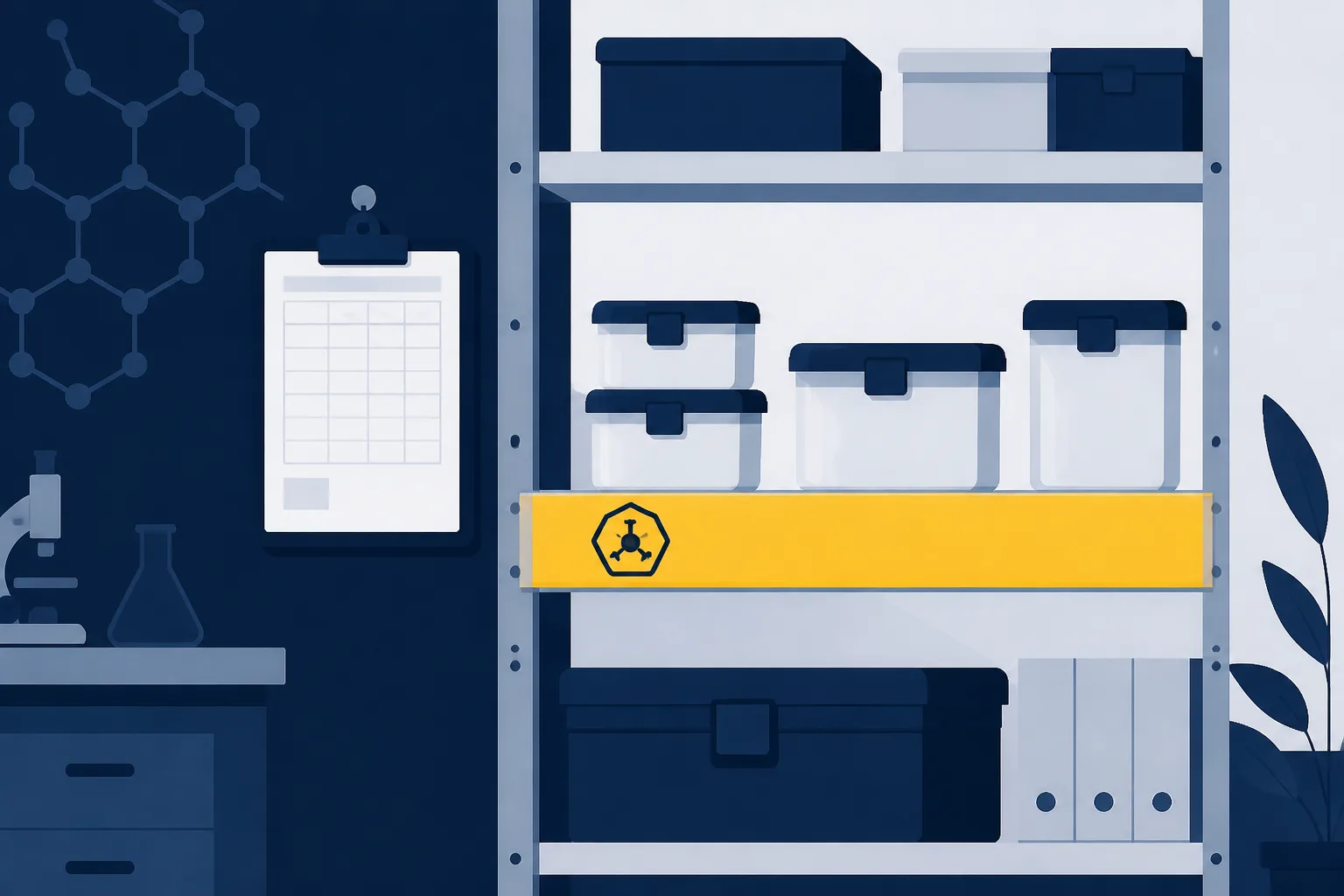
A quarantine shelf is a defined place where material awaiting disposal is held and nothing else. It is not a cupboard of old stock. The point is that anyone can see what is on it, that it is separated from active inventory, and that it does not grow unnoticed.
- Choose one low shelf in a ventilated, locked room away from heat, drains and sunlight, and mark it clearly as waste awaiting disposal.
- Keep the original container with the original label wherever possible. Never decant into unlabelled containers.
- Place each item in a sealed secondary container that would hold it if the primary container failed, and keep incompatible materials on separate trays, using the safety data sheet to decide.
- Label each tray with the identity of the contents, the date placed on the shelf, the name of the person responsible and the quantity.
- Enter every addition in the log on the day it is made, and review the shelf at a fixed interval.
Pooling through an institution that has a contract
Universities, teaching hospitals and large industrial sites often already hold a contract with a licensed hazardous-waste handler. A small laboratory nearby can ask whether it may add its material to the next collection, usually for a fee and under the host's paperwork. This is the commonest practical route in places where the market for a stand-alone contract does not exist.
Approach the host's safety or estates office, not the laboratory. Bring the log, the safety data sheets and the labels. Expect them to ask for the identity and quantity of each item and to refuse anything they cannot identify. Ask for a copy of the handler's licence and of the consignment or handover note, and file both.
Guidance for small generators
The World Health Organization's handbook on safe management of wastes from health-care activities is the most widely cited international guidance. It is written for health-care facilities and for public health managers in countries of every income level [3]. A research laboratory is not a health-care facility, so use it for its general principles of segregation, containment and handling, and use the safety data sheet and the national regulation for the specific material.
Records and chain of custody
A disposal log is the document an inspector or auditor will ask for first. Each line should show the date, the item and its identity, the quantity, the reason for disposal, the person who decided, the date and place it left the laboratory, and the name and licence number of the party that took it.
Keep the handover note from each collection with the log. If anything is later found in the wrong place, the note shows where responsibility passed. If the laboratory has material it cannot move, the log shows how long it has been there and what was done to find a route, which is the best evidence of good faith available.
The last step is to avoid creating the next shelf. Order quantities that match use, record opening dates, and revisit the stock list at fixed intervals. The articles on buffer stock and order cadence cover how to hold enough without holding too much.
References
- Waste Management and Sand Harvesting Regulations 2024National Environment Management Authority (Kenya), 2024
- National Environmental Management: Waste Act 59 of 2008South African Government, 2008
- Safe management of wastes from health-care activities, 2nd ed.World Health Organization, 2014
- New facility enhances responsible waste management at UFSUniversity of the Free State, 2021
- Waste disposal policy: hazardous materialsUniversity of Johannesburg