
Importing Research Materials into Uganda: The NDA Licence and Verification Certificate
Uganda's National Drug Authority works in two layers: a licence for the importer that expires with the calendar year, and a verification certificate for every consignment before it ships.
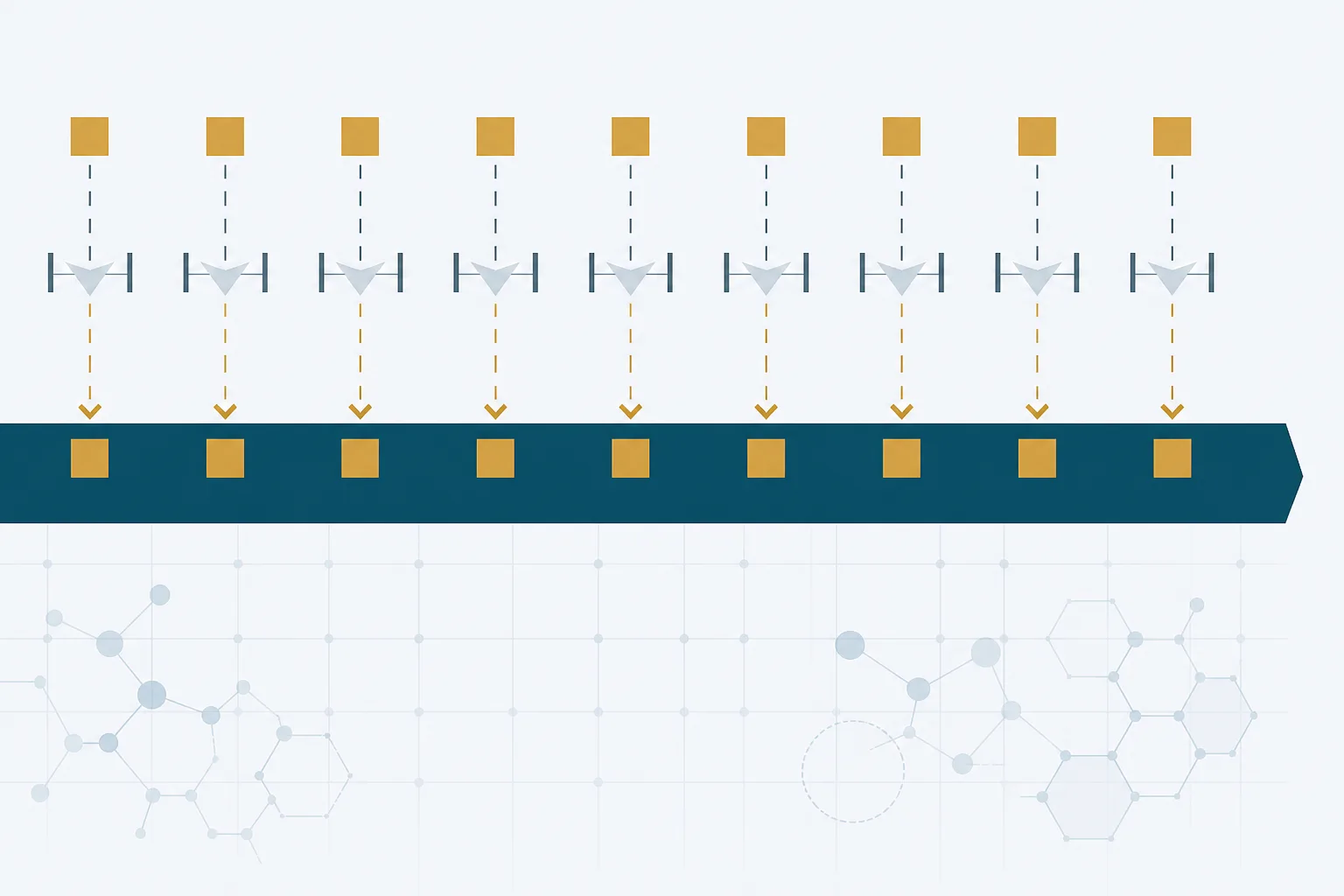
Uganda's National Drug Authority controls imports in two layers. The importer holds a licence: the statute says no person or body shall import any drugs into Uganda without one, and the regulations make it valid during the calendar year in which it is issued [1][2]. Each consignment then needs a verification certificate issued before importation, applied for by the licensed person before the goods move [2]. Neither layer can be arranged after the consignment has left the supplier.
Behind both sits a narrower rule. The Act provides that no person shall import or sell any drug unless it appears on the national formulary, and that a drug not on it may be imported only after the Authority authorises it to meet emergency or extraordinary circumstances [1]. The whole system is built around registered, listed drugs. Research material rarely is one, and that is the problem this article works through.
The National Drug Authority and the statute behind it
The Authority was established in 1993 by the National Drug Policy and Authority Statute, which became the National Drug Policy and Authority Act, Cap. 206, in the 2000 edition of the laws [3]. Among the functions the Act gives it is to control the importation, exportation and sale of pharmaceuticals [1]. The import provisions sit in Part V: section 44 requires the import licence and says it shall state the range of preparations to be imported during its validity, and section 46 governs permits for classified drugs [1].
The detail lives in the Importation and Exportation of Drugs Regulations of 2014, made under sections 44, 45, 46 and 64 of the Act [2]. The Act describes the licence as valid for one year; the regulations are more specific, fixing validity to the calendar year of issue [1][2]. Read the regulation as the operative rule: a licence granted in November runs out in December, and a renewal belongs in the year-end calendar, not on the anniversary.
Importer licensing and certification
An application for an import licence is made by a licensed person, and before issuing one the Authority must ascertain that the facility where the drugs are manufactured complies with internationally accepted Good Manufacturing Practice guidelines [2]. The licence is on Form 22 [2]. Under the verification guideline, only a person holding a valid general or limited import licence may apply for a verification certificate, and both licences and certificates are applied for and billed through the Authority's online system, NDAMIS [3].
A consignment's verification application must be accompanied by the supplier's proforma invoice, and the proforma must be authenticated by the manufacturer's or supplier's representative and by the importing entity's pharmacist-in-charge [3]. The regulation requires the application to state, for each item, the generic name and the strength of each active ingredient [2]. A catalogue shorthand is not a generic name; agree the exact wording with the supplier before the invoice is raised.
What has to be registered before it can be imported
For a registered drug, the verification review checks the product's registration status in the current Register on the date of technical verification, the current GMP status of the manufacturing facility on that date, any variation approvals not yet reflected in the Register, and authorisation from the product's local technical representative [3]. A lapse in any of those between order and review stops the certificate, even if the order was placed in good faith.
Pharmaceutical raw and packaging materials have their own verification route, but it is open only to a person licensed to manufacture drugs in Uganda, and the review checks the registration of the product the material is being imported for [3]. A research laboratory is neither the manufacturer nor making a registered product, so this route is not a way round the problem. The question is whether the material is a "drug" under the Act at all, and a label does not settle it: be clear about what a research-use-only designation does and does not claim before describing the material, then put the question to the Authority in writing and keep the answer.
Emergency and extraordinary circumstances, and their limits
The guideline defines the circumstances in which an unregistered or unlisted drug may be verified for import [3]. Extraordinary circumstances include use in clinical or field trials approved by the Authority, a confirmed stock-out with no alternative on the formulary, certain products registered by named stringent regulators, specialised healthcare needs with no alternative, vaccines needed for outbreaks, and consignments for donation or for a government ministry, project or programme [3]. Clinical work also needs its own certificate: the Act bars any clinical trial of a drug without one [1].
Laboratory research outside a clinical trial is not on that list. An application under these heads must carry documented justification, evidence of GMP certification by the Authority, a named stringent regulator or WHO prequalification, and evidence of registration or emergency approval in the country of origin [3]. Sources are restricted to manufacturers inspected by the Authority or those regulators, or WHO-prequalified sources, and the Authority reserves the right to decline any request on safety, efficacy or quality grounds [3]. A certificate issued under these heads is valid for twelve months from issue [3]. Treat all of this as discretion exercised case by case, not an exemption a research institution holds by right.
Timelines for assessment and national registration
Where a product has to be registered, the clock is measured in months. The EAC procedural guideline that partner-state regulators apply sets completeness screening within 30 working days, evaluation within 12 months, and priority review within six months; applicants have 180 calendar days to answer first-round queries and 120 days for later rounds, with no more than four rounds [4]. Registration is valid for five years [4].
The regional joint assessment, in which the Authority takes part and carries out GMP inspections, was reported to cut registration timelines from around 24 months to 8–12 months, with a median of 240 working days for joint assessment in 2019 and national approvals targeted within 90 working days of a positive recommendation [5]. Companies surveyed reported medians of 30 to 90 days from recommendation to national authorisation [6]. Treat these as ranges: they describe a process that is still changing, and a precise figure copied into a project plan will age faster than the plan.
At the port of entry
Imported drugs must travel with a certificate of analysis issued in the country of manufacture and a certificate of conformity or test report for the specific batch, and the Authority inspects each consignment on arrival against the approved specifications [2] — so spend ten minutes reading a batch certificate of analysis field by field before the goods fly. Imports must pass through ports gazetted by the Authority [2]; the verification guideline names Entebbe International Airport, Malaba and Busia One Stop Border Posts, and Nakawa [3]. Drugs refused entry must be re-exported to the supplier in the country of origin [2].
Practical sequence for a first import
- Write to the Authority describing the material by its specific name and intended laboratory use, and ask whether it is a drug under the Act and which route applies [1][3].
- Settle who the importer is: an entity holding a general or limited import licence for the current calendar year [2][3].
- Obtain the supplier's GMP evidence and, where relevant, registration evidence in the country of origin, before the proforma is raised [3].
- Have the proforma authenticated by the supplier and the pharmacist-in-charge, and apply for the verification certificate through NDAMIS [3].
- Ship only after the certificate is issued, through a gazetted port, with the batch certificate of analysis travelling with the goods [2][3].
One dated note. The verification guideline quoted here is revision 1, effective 6 September 2023, and its own header gives a review due date of 6 September 2026 [3]. That date has now passed. Check the Authority's guidelines page for a newer revision before relying on any clause above.
References
- National Drug Policy and Authority Act, Cap. 206Republic of Uganda (published by the National Drug Authority), 2000
- The National Drug Policy and Authority (Importation and Exportation of Drugs) Regulations, 2014 (S.I. 2014 No. 34)Republic of Uganda (published by the National Drug Authority), 2014
- Guidelines on the Verification of Applications for the Importation and Exportation of Drugs and Pharmaceutical Raw and Packaging Materials (INS/GDL/038, Revision 1)National Drug Authority, Uganda, 2023
- Part X: EAC Guidelines on Procedural Aspects for Applications for Marketing Authorization of Pharmaceutical ProductsEast African Community, Medicines Regulatory Harmonization Programme
- Evaluation of the Effectiveness and Efficiency of the East African Community Joint Assessment Procedure by Member Countries: The Way ForwardFrontiers in Pharmacology, 2022
- Evaluation of the effectiveness and efficiency of the East African community joint assessment procedure by pharmaceutical companies: Opportunities for improvementFrontiers in Pharmacology, 2022