
KRA eTIMS Invoices: What a Kenyan Research Buyer Should Receive
Kenya's electronic tax invoice system now matters to the person paying as much as to the person selling. For a laboratory, the invoice on file decides whether the expense can be claimed.
What must an eTIMS-compliant invoice show, when does a Kenyan institution need one to claim an expense, and what happens when the supplier is outside Kenya?
An eTIMS invoice is an electronic tax invoice issued through the Kenya Revenue Authority's Electronic Tax Invoice Management System. For a Kenyan laboratory or institution buying from a registered local supplier, it is the document that should arrive with the goods, and it should carry the buyer's own KRA PIN [1].
The reason a buyer should care is deductibility. Commentary from KPMG Kenya states that, from the 2026 year of income, expenses need to be supported by electronic invoices to be claimed, following a one-time concession for the 2025 income year [3]. Where the supplier is outside Kenya, the position is different, and this article sets out how to think about it without guessing at rules that belong to KRA and a tax adviser.
What eTIMS is and why the buyer now cares
KRA describes eTIMS as a system through which a taxpayer issues electronic invoices that are transmitted to KRA in real time [1]. Historically, a supplier's tax compliance was the supplier's concern and a buyer simply filed whatever receipt arrived. That changed when KRA tied the deductibility of an expense to the existence of an electronic invoice.
The practical shift is that a missing or non-compliant invoice is now a cost to the buyer. An expense that cannot be supported may be disallowed when the return is reviewed. A research buyer who pays a local reseller for consumables, glassware or storage equipment, and who files the receipt without an eTIMS invoice, carries that risk.
This article is a document guide. It does not interpret the Income Tax Act, and it is not tax advice. Where a point turns on the law, it says so and sends the reader to KRA or an adviser.
The fields a compliant invoice carries
A buyer does not need to audit the system behind the invoice. A buyer does need to check, on receipt, that the invoice shows the right details. The list below is a practical reading checklist, based on how KRA describes the invoice and on commentary from tax advisers [1][3]. Check the live KRA guidance for the full list of mandatory fields.
- The supplier's name and KRA PIN.
- Your institution's exact legal name and your own KRA PIN, not a personal PIN or a different branch's.
- A date and an invoice number issued by the system.
- A description of each item specific enough to identify it, with quantity, unit price and tax charged.
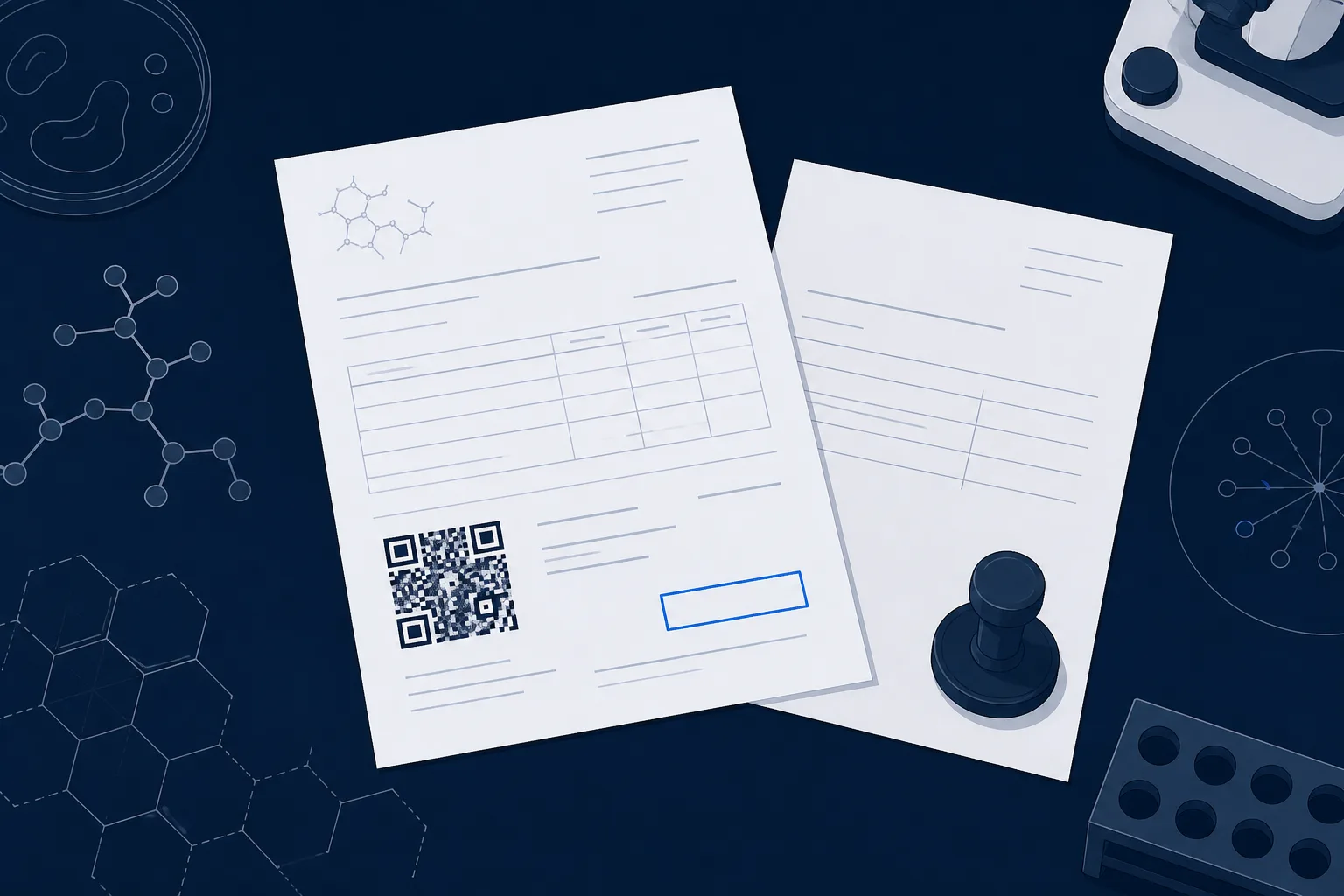
- A control unit identifier, invoice number from the system and a QR code that can be scanned to verify the invoice.
- Totals that agree with the purchase order and the delivery note.
The buyer PIN is the field most often missing. A supplier who issues an invoice to a walk-in customer may leave it blank. If the field is blank or wrong, ask for a corrected invoice at once. Correcting it months later, after the supplier's reporting period has closed, is harder.
Imports and other cases where no eTIMS invoice exists
A supplier outside Kenya is not registered on eTIMS and cannot issue one. The foreign invoice is a commercial document. What supports the Kenyan side of the transaction is the import record: the customs entry, the duty and tax receipts, and the clearing agent's documents.
KPMG's commentary discusses the categories of expense that sit outside the electronic-invoice requirement and those for which other supporting documents are accepted [3]. Whether a particular imported laboratory purchase falls within one of those categories is a matter for the institution's tax adviser. Do not assume it from this article, and do not assume it from a supplier's statement.
What a buyer can do without any advice is keep the import file complete. Hold the supplier's invoice, the airway bill or courier waybill, the customs entry, the payment records for duty and VAT, and any clearing agent's invoice together. If a reviewer later asks how an imported item was supported, one folder should answer the question.
Buyer-initiated invoicing for small local suppliers
Some local suppliers, such as a sole trader selling a piece of second-hand equipment or a small workshop, are not set up to issue electronic invoices. KRA provides a buyer-initiated invoicing route in which the buyer generates the invoice on the supplier's behalf [2]. Bowmans' 2025 note on the reverse invoicing guidelines summarises how the arrangement is meant to operate [4].
For an institution, this route needs a decision. It requires the buyer to register for the relevant functionality and to follow KRA's steps, including the supplier's details and the supplier's consent. It is not a way to avoid asking a supplier for an invoice. It is a documented fallback for suppliers who genuinely cannot issue one. Read KRA's page on the process before first use and agree the internal approvals.
Filing with the delivery note and goods-received record
An invoice proves what the supplier charged. It does not prove what arrived. A laboratory's file should hold three documents for each purchase and they should agree on item, quantity and date: the invoice, the delivery note signed on receipt, and the goods-received entry in the store's register.
| Document | Who creates it | What it proves | What to check |
|---|---|---|---|
| eTIMS invoice | Supplier, through the KRA system | What was charged, with tax, to which PIN | Buyer PIN, legal name, items, QR code |
| Delivery note | Supplier or courier, signed by the receiving officer | What was handed over, and when | Quantity and condition noted at signing |
| Goods-received record | The laboratory's store | What entered stock, under whose care | Matches the delivery note, with batch or lot where relevant |
A mismatch between any two is worth resolving while the transaction is fresh. A quantity discrepancy between the delivery note and the invoice is far easier to correct with the supplier in the same week than in the following financial year.
The 2025 concession and the 2026 position
KPMG Kenya's 2026 note describes a one-time concession for the 2025 income year under which certain expenses not supported by electronic invoices could still be claimed, and states that from the 2026 year of income all expenses need electronic invoices [3]. This is a dated position reported by an adviser and it may be refined by KRA or by legislation. Read the live KRA pages and, for any material claim, take advice.
The sensible reading for a laboratory finance office is operational. Treat the concession as having passed. Ask local suppliers for a compliant invoice at the point of sale, and do not accept a promise to send one later.
Questions for a supplier before the order is placed
- Will you issue an eTIMS invoice to our institution's PIN at the time of sale?
- Is your KRA PIN shown on the invoice, and is it active?
- Can the invoice be sent electronically as well as on paper?
- If an item is returned or a quantity is corrected, how do you issue the credit note?
- Do you issue a delivery note that matches the invoice line by line?
A supplier who answers these promptly is easier to deal with in every other respect too. A supplier who hesitates over the first question is telling the buyer something about the invoice that will eventually arrive.
What to do next
Add the buyer PIN and legal name to your standard purchase order template so suppliers receive them every time. Brief the receiving officer to reject an invoice with a blank or wrong PIN. For imports, agree with your tax adviser how the import file will be kept, and write it down.
References
- What is eTIMSKenya Revenue Authority
- Buyer Initiated InvoicingKenya Revenue Authority
- eTIMS: tax deductibility of expenses and electronic tax invoicesKPMG Kenya, 2026
- Kenya: the Revenue Authority publishes the reverse invoicing guidelinesBowmans, 2025