
Courier Corridors Beyond Nairobi: Mombasa, Kisumu, Eldoret
A parcel leaving Nairobi for the coast, the lake or the north Rift does not simply travel. It waits: at a cut-off, in an overnight depot, at a county branch. Knowing where it waits is most of the planning.
How long does a parcel take from Nairobi to the main upcountry cities, by which mode, and where does it sit overnight?
Most parcels from Nairobi to Mombasa, Kisumu or Eldoret spend one night in transit, sometimes two, and the night is spent in a depot rather than a moving vehicle. The honest answer to "how long does it take" is therefore a pair of numbers: hours of movement and hours of waiting. Couriers advertise the first and rarely state the second.
This article walks through the main domestic corridors, the modes that serve them, the places a parcel sits, and the written questions worth putting to a courier before a time-sensitive consignment travels. It does not give a transit-time table, because published promises vary by operator and change, and a figure copied into an article would age quickly. Read the times from the operator's current service page and confirm them in writing.
Four corridors and how they are served
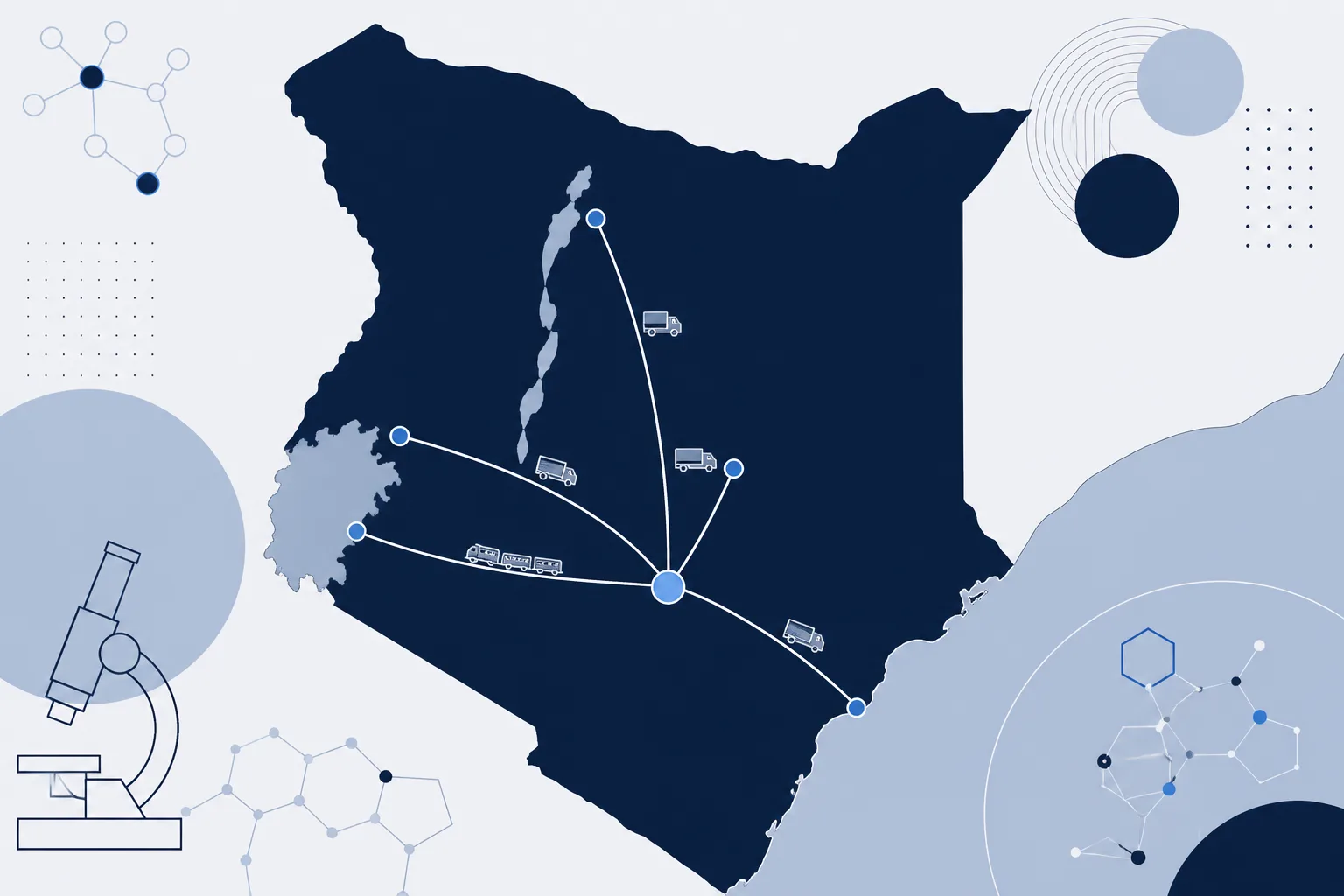
Domestic parcel traffic out of Nairobi fans out along four broad lines: the coast through Mombasa, the lake region through Kisumu, the north Rift through Eldoret, and the central highlands through towns such as Nyeri. Road is the common denominator. Mombasa is also served by rail, since the standard gauge railway links it with Nairobi, and some couriers book freight space on it. Air is used for some premium services, though whether a given parcel is flown or driven is the operator's choice and is not always disclosed.
The market that moves these parcels has changed. According to a Communications Authority statement published on 9 October 2026, private couriers handled 14.4 million domestic parcels in the quarter to June 2026, while the national post office handled 993,099, a fall of 33.2 per cent [2]. For a buyer, that confirms that a private courier is the usual carrier on these corridors, and that the choice between them is a procurement decision.
| Corridor | Typical destination | Modes commonly used | What to watch |
|---|---|---|---|
| Coast | Mombasa | Road; some rail freight | Heat and humidity at arrival; long dwell if the parcel misses the evening dispatch |
| Lake | Kisumu | Road | Rift escarpment crossing; warm lowland on arrival |
| North Rift | Eldoret | Road | Longer overnight hold in transit hubs; cooler highland conditions |
| Central | Nyeri and neighbours | Road | Shorter distance but frequent branch-to-agent hand-offs |
The table is a map of questions, not a promise about any operator. Which modes are used depends on the courier and the service level you book.
Cut-offs, overnight depots and the "next day" promise
Every courier has a cut-off: the last time at which a parcel booked in Nairobi will join that evening's outbound run. Miss it by ten minutes and the parcel sits in the Nairobi depot until the next dispatch. Nobody has done anything wrong. The clock simply rolled over.
After dispatch, parcels may be held overnight at a regional hub before the final leg. Retail delivery guidance published by a large international courier describes the logic of county zones and cross-county shipping strategy [3], and the same operator's Kenya page frames its network by service levels [4]. Neither document, nor any courier brochure, is a guarantee for a specific consignment. A promise of next-day delivery describes the service, and the service has exceptions: a public holiday, a road closure, a flooded section, a depot backlog after a sale weekend.
Nairobi to Mombasa
The coast is the corridor where the arrival matters most. Mombasa sits at sea level, with warm and humid conditions through much of the year. A parcel that has travelled overnight in a cool highland evening can arrive into a hot morning and wait on a loading bay. The practical point is that sealed packaging should be inspected on arrival for condensation, and the receiving room should be ready to take the material straight into its labelled storage condition.
If rail freight is used, ask where the parcel is held at the station terminal, and who collects it. The rail leg may be fast, but the handling at each end adds hours.
Nairobi to Kisumu and Eldoret
Both journeys go west from Nairobi over the Rift Valley and its escarpment. The road crossing is a natural bottleneck: a stalled truck can delay many parcels at once. Kisumu lies lower, on the shore of Lake Victoria, and is typically warmer on arrival. Eldoret lies on the highland plateau and is typically cooler. The same box can therefore be exposed to quite different conditions on the last leg, and the receiving laboratory should know which applies.
For temperature-sensitive consignments the useful question is how long a packed box holds its storage condition. The idea of how long a packed box holds its temperature is treated in the information-site handbook on qualifying shipping containers. A buyer who knows the answer for their packaging can compare it with the courier's stated overnight hold and see whether there is margin.
County hand-offs and the last kilometre
The final stage is often not run by the courier that booked the parcel. Many operators use branch counters, partner agents or sub-contracted riders in county towns. Each hand-off adds a scan, a wait and a chance that the parcel is placed on a shelf in an unconditioned room.
- Door delivery: the parcel leaves the branch with a rider. Give a landmark and a phone number.
- Branch collection: the parcel waits on a shelf until you arrive. Ask what the room is like and how long items are kept.
- Agent point: usually a shop. Appropriate for dry, ambient items; rarely for anything with a specific storage class.
Checking the operator's licence category
The Communications Authority publishes a postal and courier licensee register [1]. Search the operator's registered name, read the category listed against the service you are buying, and write down the date of the check. A domestic service sold by an operator whose listed category does not cover it is a reason to ask questions before booking. Licence details change, so read them live.
What to ask the courier in writing
- What is the cut-off for this service from this origin?
- Where will the parcel be held overnight, and is that space indoors?
- Who performs the final delivery: your staff, a partner or a sub-contractor?
- Will the parcel be handled at any point by a bus or matatu operator?
- What is the tracking process, and who answers if the status stops updating?
- What is the procedure if the recipient is absent: how long is the parcel held, and where?
Written answers become part of the shipping record. If the parcel arrives late or damaged, they are the baseline against which the courier's performance is judged.
Reading a tracking history
A tracking page is a list of scans, and a scan is a moment when somebody with a handheld device touched the parcel. The gaps between scans are the interesting part. A gap of fourteen hours that starts in the evening and ends in the morning is an overnight hold. A gap of fourteen hours that starts at ten in the morning is something else, and worth a question.
Save the full tracking history as a file when the parcel arrives, not only the final status. Many tracking pages show only the latest event after a few weeks. The history is the only record of where the parcel waited, and it is what you will want if the condition of the contents is later queried.
Be careful with two statuses. "Out for delivery" can mean the parcel is on a vehicle that will visit many addresses over several hours. "Delivered" can mean left with a guard, a neighbour or an agent. Neither tells you that the right person received it at a known time. The signature and the written time at the door do.
Planning around the week
Corridors behave differently across the week. A parcel booked on a Friday afternoon may not leave the Nairobi depot until Saturday, and a branch in a county town may close early on a Saturday or not open at all on Sunday. Public holidays stretch the same effect. For a consignment that should not wait, book early in the week and early in the day, and ask the courier to confirm in writing that the destination branch will be open when the parcel is due.
Peak retail periods matter too. Courier networks are built for ordinary volumes, and a sales weekend or the festive season can push depots to their limits. If a research order has no fixed deadline, avoid booking into those weeks. If it has, build in a spare day and tell the receiving room to expect a window rather than a time.
What to do next
Pick the destination, find the courier's current published times, and then ask the six questions above. Compare the stated overnight hold with the margin your packaging provides. If the margin is thin, choose an earlier cut-off, a shorter corridor or a scheduled delivery to a receiving point that can hold the parcel in the right condition.
References
- Licensee Register: Postal and Courier Licensee RegisterCommunications Authority of Kenya, 2026
- Revised Postal and Courier Market Structure to Catalyse Sector's Shift to E-Commerce, Says CACommunications Authority of Kenya, 2026
- Deliver anywhere: building a winning cross-county shipping strategyDHL Discover Kenya
- Parcel delivery to KenyaDHL Express