
Load-Shedding and Laboratory Cold Storage: What Stage 6 Does to a −20 °C Freezer
A single four-hour outage rarely costs you anything; the interruption pattern, the room temperature and the missing temperature record do.
A full, undisturbed −20 °C freezer will ride out a single four-hour outage without its contents leaving the freezer band. What damages inventory on a load-shed grid is not one blackout but the pattern of them: repeated partial thaws, a compressor that never regains lost ground in a 34 °C room, and — most commonly — no record of what the material actually experienced. South Africa's load reduction code defines staged shedding in blocks of roughly 1 000 MW, with the higher stages reserved for extreme contingency conditions [1]; at Stage 6 a given supply group can expect to be interrupted around twelve times across four days, half of those for four hours at a stretch [2].
That makes this an equipment and record-keeping problem rather than a chemistry one: what a freezer's thermal reserve actually buys, why room temperature decides whether the unit ever catches up, what backup power has to be sized against, and what the temperature record has to be able to show later.
What four hours without power actually does to a −20 °C freezer
The formal term for the thing you are relying on is holdover time. The WHO prequalification specification for cold-chain appliances defines it as the number of hours during which every point in the storage compartment stays inside its rated band, at the maximum ambient temperature of the climate zone the appliance is rated for, after the power supply has been disconnected [7]. Two features of that definition matter more than any datasheet figure: it is measured at maximum rated ambient, and it is measured with the door shut.
Heat enters through the walls and the door seal at a rate set by the temperature difference across them, and the frozen mass already inside is what absorbs it. An empty freezer is mostly air, air holds almost no heat, and so an empty freezer warms fastest — the counter-intuitive part for anyone protecting a small quantity of material in a large cabinet.
- A full cabinet. Frozen mass is the cheapest thermal reserve available; fill dead space with sealed water containers rather than leaving it as air.
- Chest geometry rather than upright. Cold air is denser than warm air and stays in the box when a lid is lifted, where an upright empties itself across the door sill.
- An intact gasket. A seal that fails a paper-slip test leaks continuously, not only when the power is off.
- Distance from the hot side of the room. Direct sun, a wall shared with a generator housing, or a dust-packed condenser coil all raise the standing heat load before an outage starts.
- Door discipline during the interruption — the only item here that costs nothing and the one most often skipped.
Published holdover figures come almost entirely from appliances specified to hold +2 °C to +8 °C for vaccine storage, not from freezers holding −20 °C [7]. Do not transfer a number across that gap. Measure your own unit instead: put a logger in the load, let a scheduled interruption run with the door shut, and read off how long the contents genuinely stayed inside the band. The result is specific to your cabinet, your load and your room, which is exactly why it is worth having.
Why Stage 6 is a different problem from a single blackout
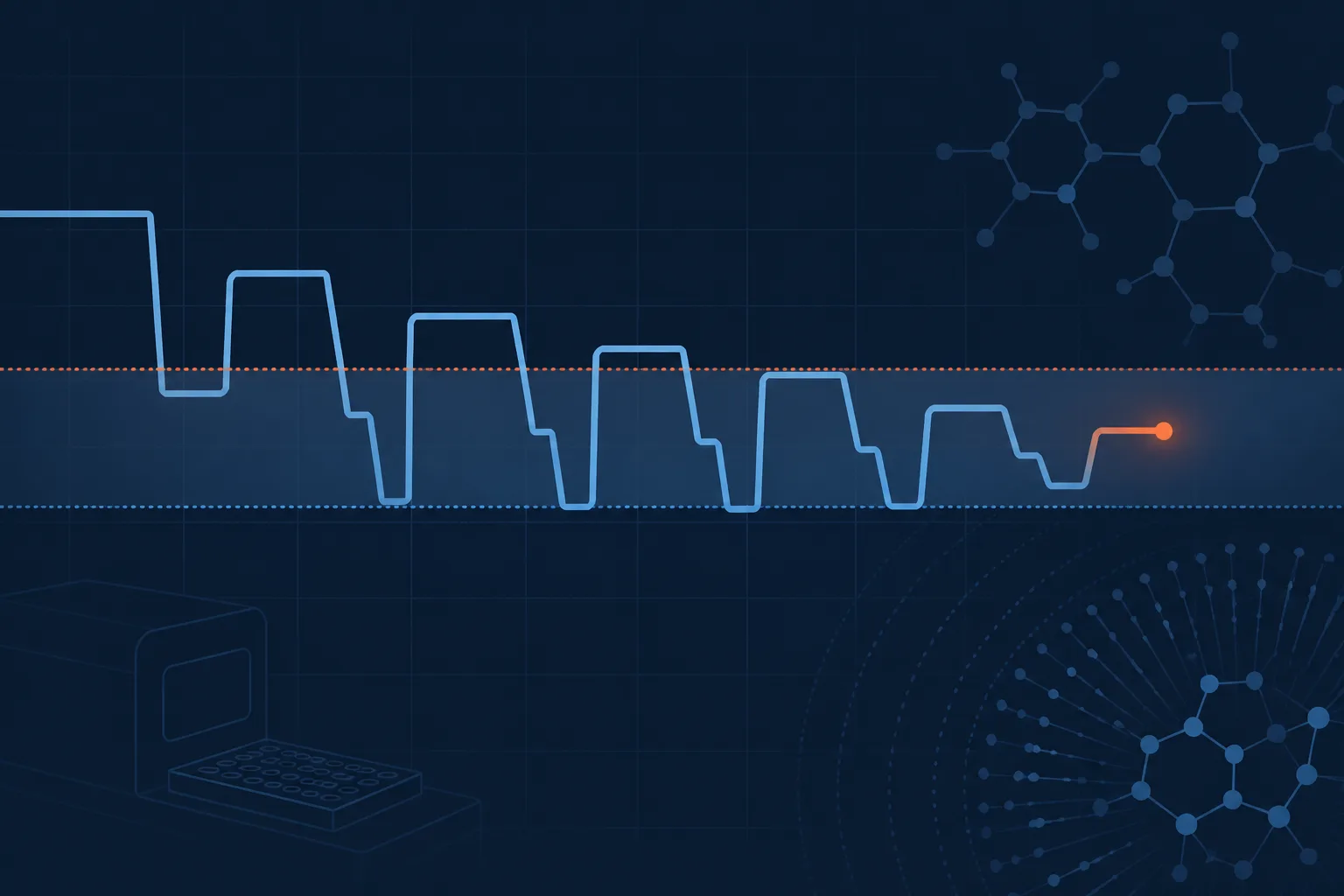
Under a deep shedding stage the interruptions arrive faster than the equipment recovers. Pulling a cabinet back down after it has warmed takes longer than the outage that warmed it, because the compressor is now rejecting heat into a room that has been getting hotter all afternoon with the air conditioning off. The unit starts each interruption warmer than it started the last, and the drift compounds across a four-day pattern.
There is a standard way to summarise a temperature history — mean kinetic temperature, defined in ICH Q1A(R2) as a single derived temperature that, if maintained over a defined period, imposes the same thermal challenge as the actual range of higher and lower temperatures experienced over that period [5]. It is a useful number for warehouse conditions and a misleading one here. An average conceals a count, and what a repeatedly shed freezer accumulates is a count: the number of times material approached or crossed a phase change, and what each of those transitions does to the material is a question about the contents rather than about the cabinet. Two freezers can share a mean and have entirely different histories.
So record the count, not the average. For each interruption the log should carry the date, the duration, the peak temperature the load reached, the room temperature at the time, and what was done about it. That is what lets a later decision about a given item be reasoned rather than guessed.
Ambient temperature is the multiplier nobody prices in
Every refrigerating appliance carries a climate-class marking, defined by the ambient range the unit was tested across under the IEC household refrigerating appliance standard [9]. It is the single most under-read label on the machine. A cabinet marked N was verified between +16 °C and +32 °C; above that, its stated performance is not a claim the manufacturer made.
| Climate class | Rated ambient range | What that means for a store room on this continent |
|---|---|---|
| SN (extended temperate) | +10 °C to +32 °C | No margin almost anywhere; treat as unsuitable for uncooled rooms |
| N (temperate) | +16 °C to +32 °C | The default on cheap imported units — loses capacity exactly when it needs to catch up |
| ST (subtropical) | +16 °C to +38 °C | Workable inland with shade, ventilation clearance and a clean condenser |
| T (tropical) | +16 °C to +43 °C | The only class with real headroom for coastal, Sahelian or unairconditioned rooms |
The climate that sets the equipment duty also sets the stability zone. WHO publishes a table assigning each member state the long-term storage conditions its regulator expects; most of the continent falls in Zone IVa or IVb — 30 °C at 65 % or 75 % relative humidity — with temperate and highland exceptions [4]. Look up your own country's row rather than assuming the continent is uniform.
- Give the cabinet its specified clearance on every side, including the top. Boxed-in units recirculate their own exhaust, so never site one in a sealed cupboard on the theory that it is 'protected' there.
- Clean the condenser on a schedule you can evidence. Dust on the coil is the cheapest performance loss to fix.
- Log the room as well as the cabinet. Without an ambient trace you cannot tell a failing compressor from a room that went to 40 °C.
- Where a purpose-built unit is out of reach, a chest freezer marked T beats an upright marked N — the class matters more than the form factor.
Backup power that can actually carry a compressor
Compressor motors draw several times their running current at the instant they start — the locked-rotor figure on the nameplate. An inverter or generator sized against running watts will trip or brown out every time the unit restarts, which on a shedding schedule is many times a day. Size against the surge rating, and check that the inverter's surge specification is quoted for long enough to cover a motor start rather than for a few milliseconds.
The second failure mode is restarting into pressure. A compressor that stops needs a few minutes for system pressures to equalise before it can start again, and supply that flickers on and off will lock it out or stall it. A restart-delay timer or soft starter between the supply and the appliance is inexpensive, and it is what stops a marginal supply from becoming a dead compressor.
- Battery inverter with automatic transfer: covers a scheduled four-hour block cleanly if sized for surge, and switches over fast enough that the cabinet never notices. The closest thing to a default answer.
- Standby generator with auto changeover: covers long or unscheduled outages, but has start latency, needs fuel on site and fails quietly when maintenance slips.
- Appliances that hold temperature by design — ice-lined and solar direct-drive units built to the WHO cold-chain specifications — buy holdover instead of runtime, a different and often more robust trade [7].
- An uninterruptible power supply alone: bridges seconds, not hours. Useful for the logger and the alarm; not a plan for the compressor.
Be realistic about generators as a standing answer. A systematic review of health-facility surveys across sub-Saharan Africa found around a quarter of facilities reporting no electricity access at all, only 28 % on average with reliable electricity — defined as power throughout service hours with no outage exceeding two hours in the preceding week — and roughly 7 % relying on a generator as their sole source [8]. Generator-only arrangements are common because they are cheap to install, and they are the arrangement most often discovered empty of diesel during the event they existed for.
The temperature record is the actual deliverable
If you cannot show what happened, nothing else here helps you. The reference practice is a calibrated digital data logger with a buffered probe and a current calibration certificate in every storage unit — the buffer being a probe immersed in glycol, glass beads or a solid block so that it reports something close to the temperature of the contents rather than of the air, which swings every time the door opens [6]. The same guidance is explicit that dormitory-style combination units are not acceptable storage equipment, and that point transfers directly to a laboratory buying on price [6].
- The logger must run on its own battery. A mains-powered monitor goes blind at exactly the moment it is needed, and a gap in the trace is indistinguishable from a warm cabinet.
- Record at an interval, not only minimum and maximum. Min/max tells you an excursion happened; the interval trace tells you how long it lasted, which is the number that matters.
- Keep the calibration certificate current and filed. An uncalibrated logger produces numbers nobody can defend.
- Set an audible and a remote alarm, and test the remote path — an alarm that only sounds in a locked building at 02:00 is decoration.
- Download and archive the trace on a schedule; many loggers overwrite their oldest data, and a shedding pattern fills memory quickly.
The nearest formal framework is the biobanking standard, which requires environmental conditions to be measured, monitored, controlled and recorded where they affect the quality of the stored material, and requires a contingency plan — back-up power, back-up storage, defined failure procedures — proportionate to the assessed risk [10]. You do not need accreditation to borrow the structure. A written contingency plan, a monitored unit, an archived trace and a defined route from a recorded excursion to a decision about the material are the whole of it.
Where the evidence is thin, and where it is not
Some of this is settled and can go straight into a procedure. The pharmacopoeial storage definitions are unambiguous: a freezer is controlled between −25 °C and −10 °C, a refrigerator between 2 °C and 8 °C, 'cold' means not exceeding 8 °C, 'cool' means 8 °C to 15 °C, and where material carries a recommended condition below −20 °C the storage location should be controlled to within ±10 °C of it [3]. Quote those numbers in your SOP, with the source named.
What is thin is everything downstream of the excursion. Holdover performance is published for vaccine refrigerators in the +2 °C to +8 °C band, not for −20 °C research freezers, so the figures that exist do not answer the question most laboratories are actually asking [7]. How many partial thaws a given lyophilised material tolerates is specific to the compound, the formulation and the container, and most of the freeze–thaw literature was generated on peptide held in solution, where a different set of variables governs stability, rather than on dry material stored under a shedding pattern. Supplier claims of stability 'for years' are worth little unless the analytical method and the storage condition behind them are stated.
One point is genuinely contested rather than merely under-studied: whether mean kinetic temperature means anything for frozen storage at all. It was derived as a thermal-challenge model for chemical degradation across a temperature range, and its source guidance frames it that way [5]. Applying it across a phase change, where damage tracks the number of transitions rather than time-at-temperature, is an extrapolation. Where you see it on freezer data, treat it as a summary statistic and keep the raw trace.
References
- NRS 048-9: Electricity supply — Quality of supply — Part 9: Code of practice for load reduction practices, system restoration practices and critical load and essential load requirements under power system emergenciesNational Energy Regulator of South Africa (NERSA), 2019
- Load shedding schedule interpretationEskom Holdings SOC Ltd
- General Chapter <659> Packaging and Storage RequirementsUnited States Pharmacopeia–National Formulary (USP–NF), 2020
- Stability conditions for WHO Member States by Region (Annex 2, Appendix 1, WHO Technical Report Series No. 953)World Health Organization, 2018
- ICH Q1A(R2): Stability Testing of New Drug Substances and ProductsInternational Council for Harmonisation / European Medicines Agency, 2003
- Vaccine Storage and Handling ToolkitUnited States Centers for Disease Control and Prevention, 2024
- PQS performance specification E003/RF03.5: Refrigerator or combined refrigerator and water-pack freezer, compression-cycleWorld Health Organization, Performance, Quality and Safety (PQS) prequalification programme, 2020
- Limited electricity access in health facilities of sub-Saharan Africa: a systematic review of data on electricity access, sources, and reliabilityGlobal Health: Science and Practice, 2013
- IEC 62552-1:2015 Household refrigerating appliances — Characteristics and test methods — Part 1: General requirementsInternational Electrotechnical Commission, 2015
- ISO 20387:2018 Biotechnology — Biobanking — General requirements for biobankingInternational Organization for Standardization, 2018