
Warehouse and Depot Conditions in Transit: What a Parcel Sits In Between Scans
A sorting facility is built for conveyors, vehicles and people, not for the temperature of your parcel. What that means in a hot month, what a carrier will and will not tell you, and how to write the transit record afterwards.
A courier depot is climate-controlled, where it is controlled at all, for the people who work in it and the equipment that sorts parcels — not for the temperature of any individual parcel. Unless a shipment has been booked and labelled as temperature-sensitive, it sits in whatever the building provides: a sort hall that may be conditioned, a loading bay with doors open to the yard, and an overnight holding area under a roof that has been in the sun all day. The conditions are rarely hostile by design. They are simply unmanaged for your purposes, and unrecorded.
This article zooms in on the buildings that the cluster pillar on the final forty-eight hours walks through in passing. It keeps to general, sourced statements about how such facilities work; it does not describe any particular carrier's premises, because those conditions vary by site and change with the season, and only a site-specific answer is worth anything.
What a sorting facility is and is not climate-controlled for
Good distribution practice draws a clear line between spaces that hold temperature-sensitive goods and spaces that merely pass them through. WHO's guidance on temperature mapping requires mapping for any space allocated to storing products with a labelled storage temperature — freezer rooms, cold rooms, controlled storage areas, quarantine areas and receiving and loading bays — and adds that packing areas, loading bays and areas where goods are temporarily held in transit may also be mapped and monitored, although temperatures there are likely to fluctuate because doors are opened [1]. The operative phrase is ‘may also’. For a pharmaceutical distributor holding labelled stock, mapping those areas is expected. For a general parcel network, nothing obliges it.
The guidance for temperature-controlled transport sets out what a controlled en-route warehousing step looks like: temperature monitoring, availability of refrigerated or controlled room temperature storage when required, defined storage instructions, and defined actions in the event of delays [2]. Read it as a checklist of what an ordinary parcel does not get. Those controls are activated by a booking and a label. A research consignment sent on a standard express service has neither, so it is sorted, staged and held exactly like the parcel next to it.
Weekend and holiday holds
The longest unmonitored interval in most journeys is not a flight or a road leg; it is a hold. A parcel that misses the last delivery round on a Friday typically waits until Monday, and a public holiday on either side extends that to three or four days. Customs referrals raised late in the week behave the same way. Nothing is wrong with the parcel during that time, and nothing is being done to it. It is simply sitting in the building.
This is where packaging assumptions fail quietly. An insulated shipper with conditioned packs is a system with a finite duration, not a storage location, and a hold that outlasts it turns the box into a slow-warming container at room ambient. Before relying on one, ask for the hold time a qualified shipper can actually guarantee and compare it with the worst weekend your route has produced, not the average one.
Roof-space temperatures in uninsulated warehousing
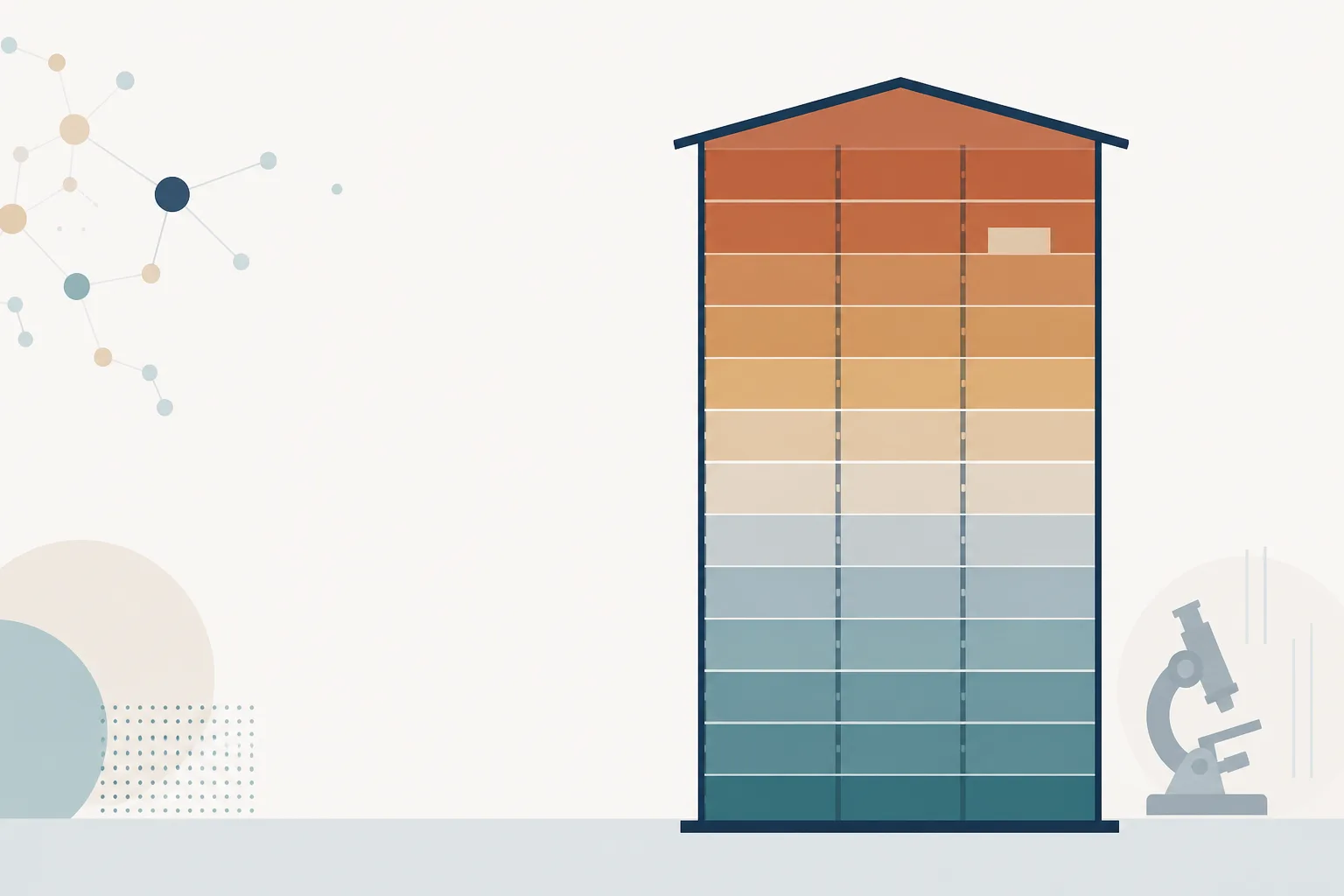
Warm air rises and collects under the roof. WHO's mapping guidance singles out high-bay pallet racking stores as particularly susceptible to temperature stratification and requires them to be mapped over their full working height, with sensors arranged vertically at each point on the grid [1]. The practical consequence for a buyer is simple: a parcel racked on an upper level in a tall, uninsulated shed is in the hottest part of the building, and a thermometer at head height near the door says nothing about it.
The only systematic measurements of this kind in the region come from medicine stores rather than courier depots, but they show the range such buildings reach. A study of 27 health-facility pharmaceutical stores in southern Malawi recorded storage temperatures from 13.8 °C to 42 °C, with 88.9% of facilities recording maximum temperatures above 30 °C; most facilities had air conditioning, but few used it because of electricity problems [3]. Stores fitted with insulated panels and heat-reflecting paint ran measurably cooler than the rest [3]. The lesson transfers: building fabric decides more than the thermostat does.
Grid resilience and holdover
A conditioned hall is only conditioned while it has power, so the useful question about any facility is how it behaves when the supply fails and for how long it coasts — the same holdover question the cold-storage articles on this site ask of a freezer. The answer varies by country and has changed recently in the region's largest grid. South Africa has had no load-shedding since 16 May 2025, and between 1 April and 30 July 2026 demand was met 100% of the time [4]. The system operator's own outlook is less settled about the end of the decade: it expects significant plant shutdowns and the end of an import contract between 2029 and March 2030, reducing baseload capacity by 9.5 GW and requiring measures to mitigate potential inadequacy [5].
Elsewhere on the continent, supply reliability ranges from dependable to intermittent, often within a single country. Frame the question accordingly. Do not ask whether a facility suffers outages; ask what happens to the sort hall and the holding area during one, whether there is standby generation and what it powers, and whether the answer changes at night or at weekends when a site runs with minimal staff.
What carriers will and will not tell you
Expect process answers, not temperature answers. A carrier's local station can usually confirm cut-off times, delivery round times, whether it delivers on Saturdays, how long it holds a parcel before return, whether a temperature-sensitive service exists on your lane and what it costs. It will rarely publish the temperature of a given depot, because for a general network that figure is not measured, and where it is measured it describes one building in one season. Treat any unsolicited reassurance about conditions as a statement of intent rather than a record.
Asking the right question when booking
The questions that produce useful answers are about time and handling, because those are what the carrier controls and records. Ask them before the order is placed, in writing, and keep the replies:
- Which facilities will the consignment pass through between the destination gateway and delivery, and how long does a parcel typically wait at each?
- What happens to a consignment that misses the last round before a weekend or a public holiday — where is it held, and until when?
- Is a temperature-sensitive or priority-handling service available on this lane, and what does it change in practice?
- Can the consignment be held for collection at a named branch counter rather than put on a delivery round?
- If the site loses mains power, does standby supply cover the holding area as well as the sort equipment?
- Will the carrier record a reason, verbatim, for any hold or failed attempt?
Documenting the transit record afterwards
Once the consignment is in your hands, the depot stays become part of your record whether you document them or not. The formal method for evaluating excursions treats transport as a window running from despatch to arrival, and requires the duration of any excursion and the peak temperature reached to be stated alongside any summary figure [6]. The route-profiling method goes further, pairing the temperature trace with a checklist that records the date and time of entry to and exit from each control point, so that each part of the trace can be tied to a building or a vehicle [7].
A buyer can do a light version of the same. Download the logger at receipt, export the tracking history with its timestamps, and mark on the trace where each scan fell. Holds become visible as flat or slowly rising stretches between scans, and the depot nights show as the long ones. File the trace, the tracking export and the carrier's written replies together with a written receipt log with acceptance criteria set in advance. The next time you order on the same route, that file tells you which facility and which day of the week to avoid — and the companion article on reading the logger explains how to interpret the trace itself.
References
- Temperature mapping of storage areas (Technical supplement 8 to WHO Technical Report Series No. 961, Annex 9)World Health Organization, 2015
- Temperature-controlled transport operations by road and by air (Technical supplement 12 to WHO Technical Report Series No. 961, Annex 9)World Health Organization, 2015
- Temperature variations in pharmaceutical storage facilities and knowledge, attitudes, and practices of personnel on proper storage conditions for medicines in southern MalawiFrontiers in Public Health, 11, 2023
- Eskom reports 441 days without load sheddingSAnews, South African Government News Agency, 2026
- Medium-Term System Adequacy Outlook 2026–2030National Transmission Company South Africa (NTCSA), 2025
- General Chapter <1079.2> Mean Kinetic Temperature in the Evaluation of Temperature Excursions During Storage and Transportation of Drug ProductsUnited States Pharmacopeia–National Formulary (USP–NF)
- Transport route profiling qualification (Technical supplement 14 to WHO Technical Report Series No. 961, Annex 9)World Health Organization, 2015