
Collection Points, Lockers and Doorstep Delivery in Nairobi
Three hand-off models reach a Nairobi address: the door, the agent shop and the locker. Each decides where a parcel waits, for how long, and who can prove it was collected.
Should a Nairobi research buyer have a consignment delivered to the door, to an agent shop or to a locker, and what does each do to the parcel's waiting time and conditions?
A Nairobi consignment can reach its recipient in three ways: a rider or van takes it to the door, an agent shop holds it for collection, or a locker cabinet holds it behind a code. The right choice for a documented research consignment is the one that minimises unattended waiting time, keeps the parcel out of direct sun, and leaves a record of who took it and when.
For an institution with a staffed receiving point, doorstep delivery to that point is normally the strongest option. For an individual office or a small laboratory with irregular staffing, a collection point can be reasonable if its holding conditions and collection record are understood in advance. This article sets out the differences so the choice is made deliberately and not by whatever the checkout offered.
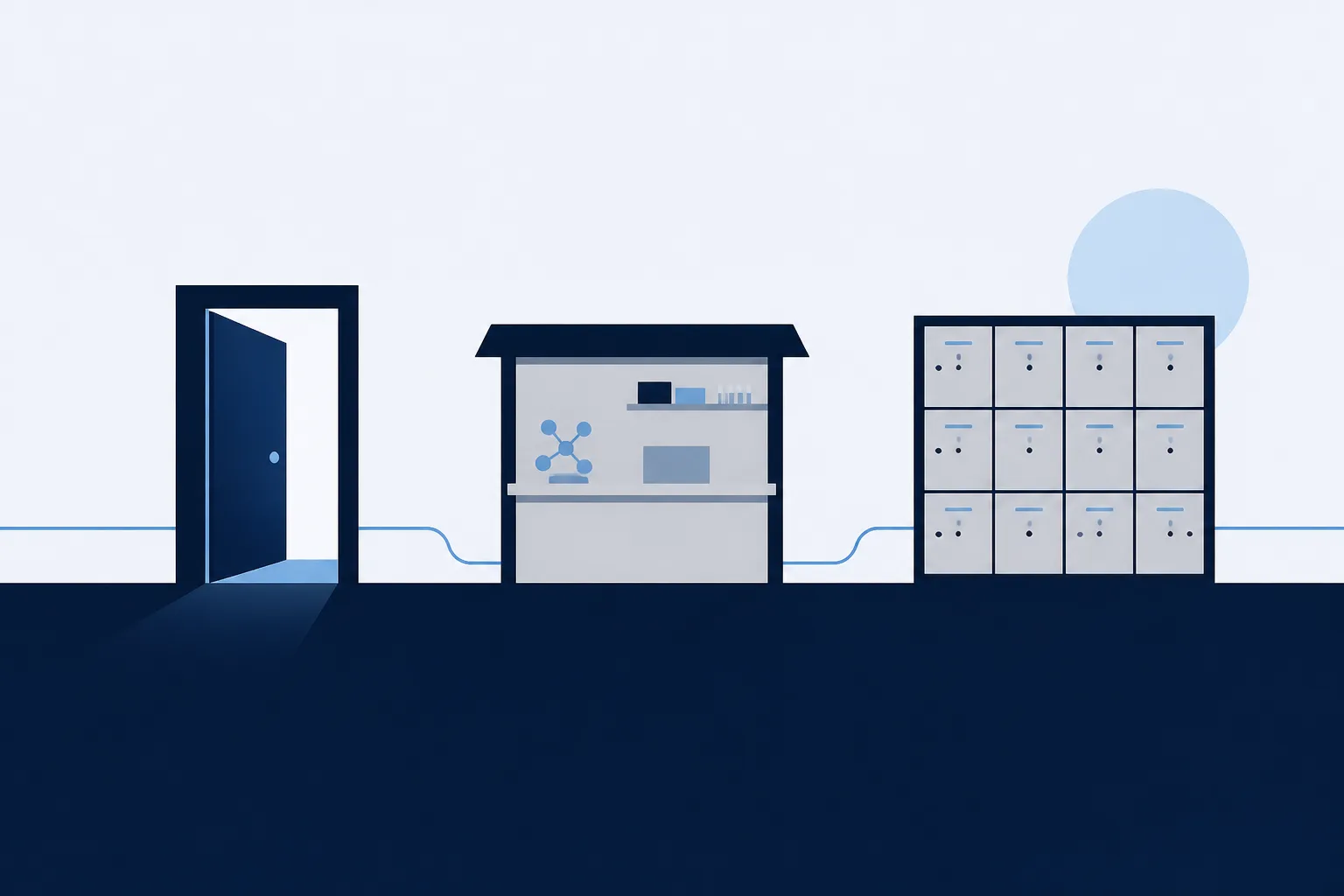
Three ways a Nairobi parcel reaches you
Doorstep delivery means the courier attempts to hand the parcel to a named person at a stated address. The courier carries the parcel for the whole of the final leg and the waiting happens, if at all, on the road.
Agent-shop collection moves the waiting from the road to a retail premises. The model is widely used in Kenya: a network of small shops accepts parcels from couriers and holds them until the recipient arrives. Vodafone's 2021 write-up of one such network describes the idea as extending delivery to the neighbourhood level where street addressing is weak [1]. The parcel then sits wherever that shop keeps parcels.
A locker is a cabinet with numbered compartments opened by a code sent to the recipient. It removes the human at the hand-off but not the waiting. The parcel sits in a closed compartment until the code is used.
The Communications Authority of Kenya reported in 2026 that private couriers had taken a growing share of domestic parcels, with Posta's domestic volume falling in the same period [2]. The practical consequence is that more consignments now pass through private networks whose holding practices differ from operator to operator. Do not assume that one operator's collection point behaves like another's.
Waiting time and where the parcel sits
The question to ask of any hand-off model is how long the parcel waits unattended, and in what place. Speed of the last kilometre matters far less than this.
| Hand-off | Where the parcel waits | Who controls the waiting | What to ask |
|---|---|---|---|
| Doorstep | In the vehicle, then at the address if nobody is present | The courier and the recipient's presence | What is the delivery window, and is a call made before arrival? |
| Agent shop | On a shelf or behind a counter in a retail premises | The shop owner, within the network's rules | How many days is a parcel held, and is the shelf indoors and shaded? |
| Locker | In a closed compartment in a public cabinet | The locker operator, until the code is used | Where is the cabinet sited, and for how long is a compartment held? |
None of these is inherently unsuitable. Each is unsuitable if nobody has asked the question. A parcel handed to a shop at nine in the morning and collected at noon has waited three hours. A parcel left in the same shop over a weekend has waited much longer, in conditions nobody recorded.
Heat, sun and the locker cabinet
A metal cabinet in direct afternoon sun behaves like any enclosed metal box. The air inside can run well above the outside temperature, and the effect is strongest on a side street that faces west. Nairobi's altitude moderates night and morning temperatures, but a closed compartment in sun is a different environment from the shaded air a thermometer on a wall would report.
The WHO's model guidance on storing and transporting time- and temperature-sensitive products treats the control of exposure during hand-over and holding as part of the supply chain, not as an afterthought [5]. A laboratory does not need to apply pharmaceutical distribution rules to a research consignment, but the underlying point transfers directly: every place a parcel waits is a place its temperature should be known.
If a locker is the only option, choose the earliest practical collection time, ask where the cabinet is sited, and prefer a covered or indoor location. If the consignment includes a temperature indicator or logger, read it at collection and file the reading with the delivery record. For the storage question itself, a plain-English answer on whether a day on a shelf matters is better placed on an information site than here.
Proof of collection and who signs for an institution
A delivery record is useful only if it can be tied to a named person and a time. Doorstep delivery usually produces a signature or a photograph. An agent shop typically records a collection in its own system. A locker records that a code was entered.
For an institution, a record that says only that a code was used does not show who held the parcel afterwards. A better practice is for the receiving officer to log the parcel at the point of collection: date, time, the collection point, the officer's name, the condition of the outer packaging and the reading of any indicator included. That log, and not the operator's message, is the record the finance office and an auditor will later want.
Decide in advance who may collect. If a courier or shop asks for an identity document and a code, the person named on the order should be the person who presents them. A parcel collected by a colleague or a driver without prior notice creates a gap in the record that is difficult to close later.
Failed deliveries and the redelivery loop
Doorstep delivery fails when the recipient is absent, the address cannot be found, or the building has controlled access. The courier then holds the parcel, usually in a vehicle or at a depot, and schedules another attempt. Each loop adds hours or days of unattended waiting [3].
The best defence is simple. Give a mobile number that will be answered, name an alternate recipient, state the building and floor, and make sure the gate or reception knows a parcel is expected. For addresses that are hard to describe, the companion article on delivery to an address that is not on the map covers the addressing problem. This article assumes the address exists.
If two attempts have failed, stop and decide. Redirecting the parcel to a staffed collection point may be faster and less exposed than a third attempt at a door nobody opens.
Posta Kenya's branches and private agent networks
Posta Kenya operates a branch network and, as reported in 2019, expanded its logistics business with a Nairobi hub [4]. Branches are staffed public premises with fixed opening hours, which suits collection by a named officer on a working day. Private agent networks are more numerous and usually open longer, but the premises vary from a dedicated parcel counter to a corner of a general shop.
Neither is better in the abstract. The comparison that matters is practical: which point is closest to the receiving laboratory, which is open when the receiving officer is available, and which will state its holding period in writing. Check the operator's licence category on the Communications Authority's published register before relying on it for a documented consignment.
A decision table for research consignments
| Situation | Usually the better hand-off | Reason |
|---|---|---|
| Institution with a staffed receiving point | Doorstep to the receiving point | A named officer signs and logs on arrival; no unattended waiting |
| Small office, irregular staffing | Staffed collection point, early collection | Avoids repeated failed attempts; holding conditions can be asked about |
| Consignment with an indicator or logger | Doorstep or same-day collection | The reading can be taken and filed straight away |
| Weekend or public holiday approaching | Defer dispatch or use a staffed point | Avoids a parcel sitting unattended over a closure |
What to do next
- Decide the hand-off model before ordering, and name the person who will receive or collect.
- Ask the operator in writing where the parcel is held, indoors or outdoors, and for how long.
- Confirm the operator's licence category on the Communications Authority register.
- Log the receipt: date, time, place, officer, packaging condition and any indicator reading.
- File the log with the delivery note and invoice so the three tell one story.
References
- Pick-Up Mtaani: making e-commerce deliveries work in KenyaVodafone Group, 2021
- Revised Postal and Courier Market Structure to Catalyse Sector's Shift to E-Commerce, Says CACommunications Authority of Kenya, 2026
- Kenya's courier sector races to keep pace with e-commerce boomThe Standard (Kenya), 2026
- Posta expands logistics business with Nairobi hubCapital FM (Kenya), 2019
- TRS 961, Annex 9: Model guidance for the storage and transport of time- and temperature-sensitive pharmaceutical productsWorld Health Organization, 2011